Competitive Intelligence, Reimagined with AI Agents
From repetitive research to an orchestrated intelligence workflow
Competitive intelligence used to be a recurring manual exercise: research competitors, scan multiple sources, identify meaningful signals, validate them, add context, synthesize the findings, and finally turn everything into a structured report.
I redesigned that workflow as an AI-native research system, using a set of specialized agents that work together rather than asking one AI model to do everything.
Collect → Filter → Enrich → Report
The result is a repeatable pipeline that turns scattered market signals into a structured competitive intelligence report.
The problem
Competitive research was repetitive by design
Every research cycle required going through many of the same steps again:
Find information → decide what's relevant → research further → validate → synthesize → write
The challenge wasn't simply the amount of information.
It was the amount of judgment and repetition involved in moving information from one stage to another.

A researcher had to
Search across multiple sources
Identify potentially relevant competitor activity
Separate meaningful signals from noise
Research individual signals in more depth
Add context from the broader banking and payments landscape
Compare findings across competitors
Structure the information into a coherent report
Repeat the process again in the next cycle
The result was a workflow that was highly dependent on manual effort
and difficult to scale consistently.
The opportunity

The shift
From one AI prompt to a system of specialized agents
Rather than building one large prompt that attempts to research, analyze and write everything at once, I broke the workflow into distinct responsibilities.
Each agent has a specific job, specific inputs and a defined output.

01 — Collect
Finding the signals

The first agent is responsible for gathering potential competitive intelligence.
Rather than beginning with a blank page every research cycle, the Collector searches the defined competitive landscape and produces structured findings that can be passed to the next stage.
02 — Filter
Turning information into signal

Collection produces volume. But not everything collected deserves space in the final report.
The Signal Filter acts as the second layer of judgment.
It evaluates candidate findings against a defined framework to determine:
Is this actually a meaningful competitive signal?
Is it relevant to the CardSuite landscape?
Is there enough evidence?
Is it new or materially different?
Is it worth spending enrichment effort on?
03 — Enrich
Turning a signal into intelligence

A headline isn't intelligence.
A signal becomes useful when there is enough context to understand what happened, why it matters and what evidence supports it.
The Enrichment agent takes the filtered findings and investigates them further. It adds:
supporting evidence
relevant context
competitor information
market context
source information
implications that can help the report generator understand the finding
04 — Report
From intelligence to a usable product
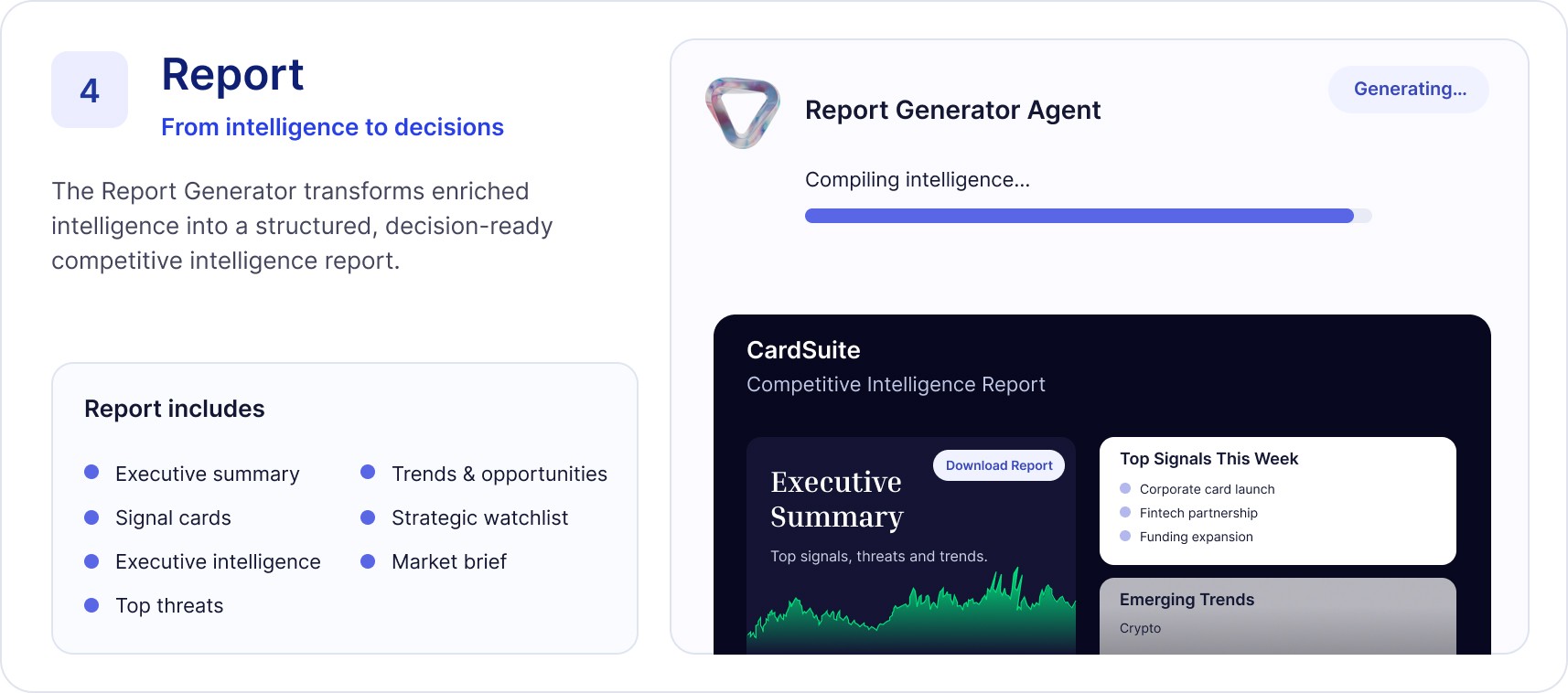
The final agent is responsible for transforming enriched findings into the competitive intelligence report.
Instead of receiving hundreds of raw sources, it receives a structured set of researched findings.
This lets the Report Generator focus on a different problem:
How should this intelligence be organized so that someone can quickly understand what matters?
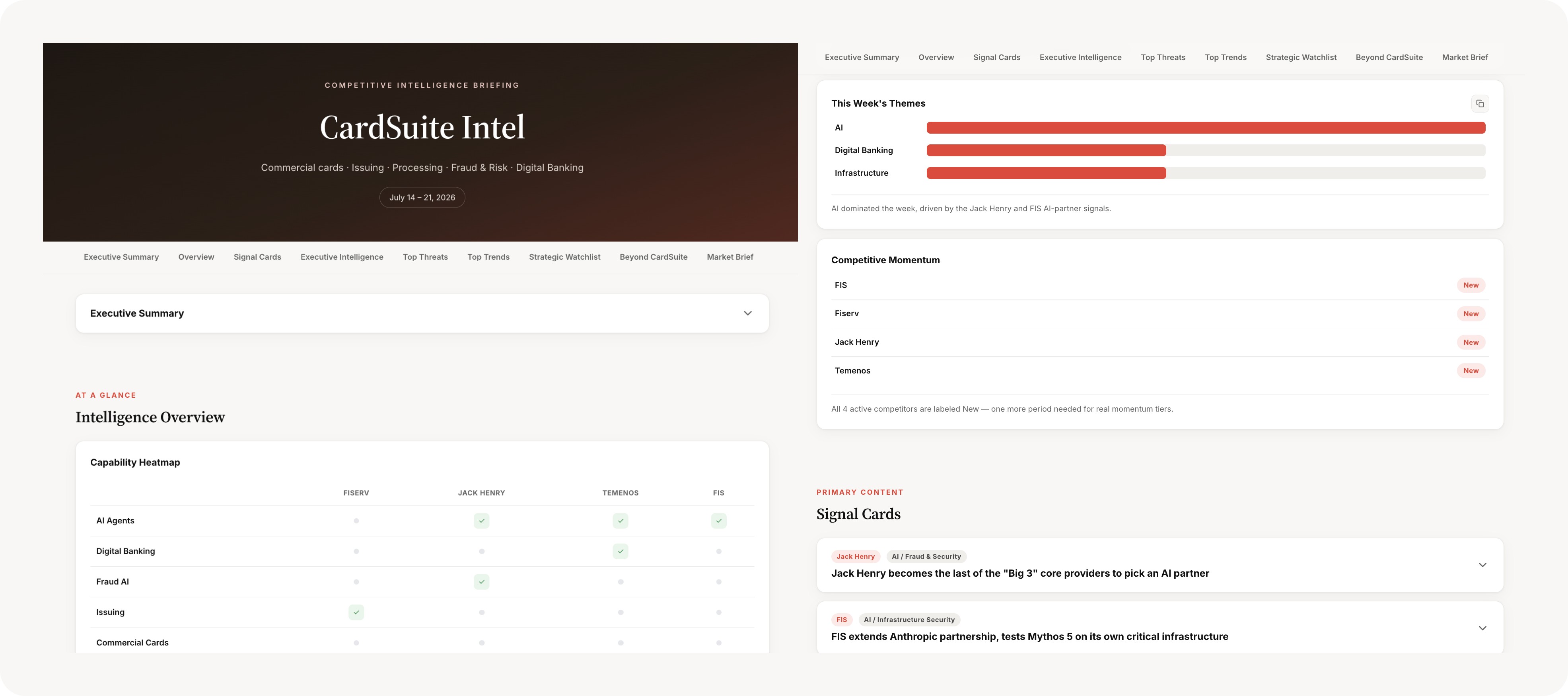
The resulting report is structured around decision-oriented sections such as:
Executive Summary
Signal Cards
Executive Intelligence
Top Threats
Emerging Trends
Strategic Watchlist
Broader Banking & Fintech Market Brief

The design challenge
AI doesn't remove complexity.
It moves it.
One of the biggest design lessons from this project was that building an AI workflow isn't simply about giving a model more instructions.
The complexity moves into the system design.
I had to think about:
What should each agent know?
Giving every agent the entire context creates unnecessary complexity.
What should each agent produce?
Every stage needs an output that the next stage can reliably consume.
Where should judgment happen?
Some decisions belong during filtering, while others belong during enrichment or reporting.
How do we prevent hallucinated certainty?
The workflow uses source and evidence requirements so that the report is grounded in researched findings rather than treating every generated statement as fact.
How do we make the workflow repeatable?
The process needs to behave consistently across research cycles rather than depending on how someone happens to phrase a prompt that week.
Outcome
From repetitive research to a reusable intelligence system
The biggest outcome wasn't simply generating a report faster. It was creating a repeatable research capability.